The music industry has changed dramatically. For today's independent country artist, having a great voice, writing good songs and putting on a memorable show are no longer enough. Success increasingly depends on understanding the business behind the music.
There was a time when aspiring country singers dreamed of driving into Nashville, landing a record deal, hearing their first single on the radio and watching the money follow.
That dream still exists. But for thousands of working country entertainers across America, the reality is quite different.
Today's artist is often their own booking agent, marketing manager, social media director, merchandise seller and business administrator. Between rehearsals, recording sessions and performing, they're also answering emails, promoting upcoming shows and trying to work out whether their latest release has earned enough to cover studio costs.
The good news? There have never been more ways for an independent country artist to reach an audience and generate income.
The challenge is learning how to make those opportunities pay.
1. Streaming: Millions of Listeners Don't Necessarily Mean Millions of Dollars
Let's start with the question almost every independent artist asks:
How much money can I actually make from Spotify, Apple Music and other streaming services?
The answer is more complicated than many people realize.
Unlike selling a CD for $15, streaming doesn't provide one fixed amount every time someone plays your music.
Spotify calculates royalties based on an artist's share of eligible streams within different markets, rather than a guaranteed payment for every play.
Apple Music has historically reported an average rate of approximately one cent per play for individual paid plans, but that figure dates from 2020, includes recording and publishing royalties paid to rights holders, and is not a guaranteed current payment to the performing artist.
To put streaming into perspective, consider a hypothetical independent artist receiving an effective recording royalty of $0.003 per stream.
| Annual streams | Illustrative recording royalties |
|---|---|
| 10,000 | $30 |
| 100,000 | $300 |
| 500,000 | $1,500 |
| 1,000,000 | $3,000 |
| 5,000,000 | $15,000 |
These are illustrations, not published platform rates or guaranteed artist payments. Actual royalties vary by streaming service, country, subscription type, contractual arrangements and rights ownership. These examples also exclude separate songwriting royalties and potential deductions.
Another important point: Spotify requires a track to accumulate at least 1,000 streams during the preceding 12 months to qualify for its recorded-music royalty pool, alongside other eligibility requirements.
For an emerging artist, streaming income alone is unlikely to support a full-time music career.
But streaming has another value.
It allows someone who has never heard of you to discover your music.
That listener might eventually buy a ticket, order a T-shirt, share your music or become a loyal fan.
Think of streaming as one part of your income strategy, not the entire strategy.
2. Live Performances: Still the Heart of a Working Country Artist's Income
There's something about country music that comes alive in a bar, dance hall, honky-tonk or festival.
And for many independent country artists, live performances remain one of the most immediate ways to generate income.
Opportunities include:
- Honky-tonks and country music bars.
- Restaurants featuring live entertainment.
- Dance halls and country nightclubs.
- County fairs, rodeos and festivals.
- Corporate events and private parties.
- Weddings and special celebrations.
- Opening slots for established performers.
- Ticketed headline shows.
Fees vary enormously depending on location, audience size, reputation, performance length and whether you're appearing solo or with a full band.
A solo acoustic entertainer might negotiate a few hundred dollars for a local engagement. An established regional band could negotiate considerably more for a festival, wedding or corporate event.
But it's important to distinguish gross performance fees from actual earnings.
Consider a four-piece band receiving $1,200 for a show.
After paying $200 for travel and sound expenses, $1,000 remains. Split four ways, that's $250 per musician before any other expenses or taxes.
Suddenly, the $1,200 booking doesn't seem quite so lucrative.
For country artists building a sustainable business, the objective should not simply be booking more shows. It should be booking more profitable shows.
That means understanding travel distances, equipment costs, audience potential, merchandise opportunities and repeat bookings.
A regular local engagement paying slightly less may be financially superior to a distant performance that consumes two days and significant travel expenses.
3. Merchandise: Your Fans Can Be More Valuable Than Your Streams
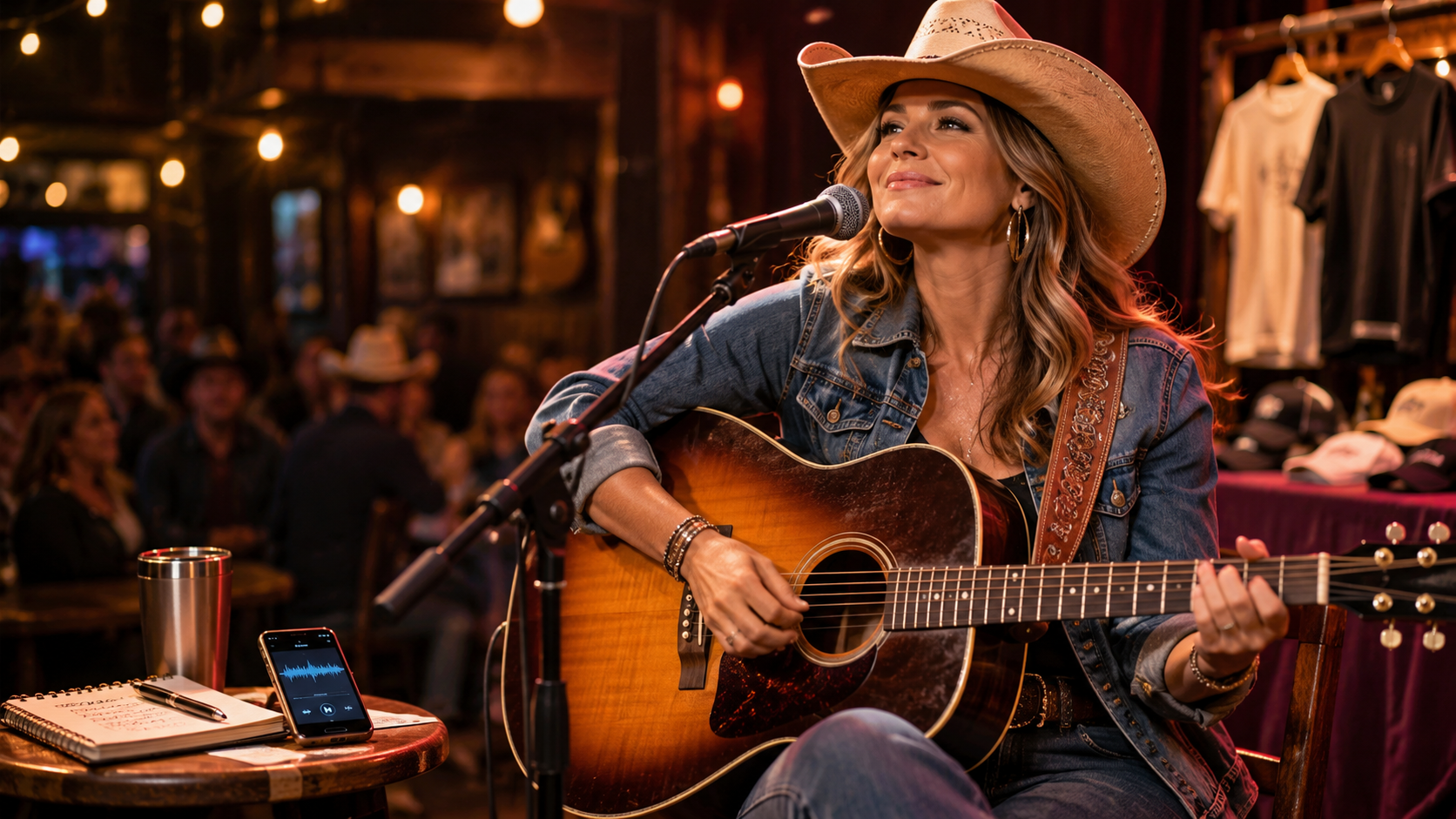
Imagine performing for 150 people at a country music venue.
You put on a great show. The audience responds enthusiastically, and several people approach you afterward.
Now imagine having nothing available for them to buy.
You've missed an opportunity.
Country fans often enjoy supporting performers directly, particularly when they can take home something that reminds them of a great evening.
T-shirts, baseball caps, signed CDs, posters, koozies and other merchandise can turn a successful show into a much more profitable event.
Here's a simple example.
You sell 20 T-shirts at $25 each.
That's $500 in merchandise revenue.
If each shirt costs $12 to produce, your gross merchandise profit is $260 before sales taxes, payment fees, venue commissions and other costs.
That's a significant addition to a night's performance fee.
And unlike a digital stream, merchandise provides something tangible. Every fan wearing your shirt becomes a walking advertisement for your music.
The emergence of print-on-demand suppliers also means independent artists don't necessarily have to invest thousands of dollars in merchandise inventory.
Companies such as Printful and Printify allow artists to sell branded products online, with items manufactured when ordered and shipped directly to customers.
Margins can be smaller than bulk ordering, but the financial risk is reduced.
Before selling merchandise at a live venue, always confirm whether the venue requires a commission from sales.
The key is to develop merchandise that fans genuinely want to wear, rather than simply putting your name on a shirt.
4. Sell Music Directly to Your Fans
Streaming isn't the only way to distribute recordings.
Independent artists can sell digital downloads, CDs, vinyl and special-edition recordings directly to their audience.
Bandcamp, for example, generally retains 15% of digital sales, reduced to 10% after reaching its qualifying sales threshold, and 10% of physical merchandise sales. Payment-processing charges are separate.
Imagine 100 loyal fans buying a $10 digital album.
That's $1,000 in gross sales before platform charges and any other expenses.
The same fans could potentially stream those songs thousands of times without generating comparable revenue for the artist.
Of course, convincing someone to buy an album requires an established connection.
That's why developing a loyal audience is so valuable.
A thousand genuinely interested fans who attend shows, purchase merchandise and support new releases may be commercially more valuable than a much larger audience that occasionally streams one song.
5. Songwriting: Don't Leave Royalties on the Table
For artists writing their own material, there are additional opportunities to earn money beyond performing and recording.
In the United States, songwriting and recording royalties are separate.
Songwriters should understand three particularly important organizations:
ASCAP or BMI: Performing rights organizations that collect and distribute certain royalties when compositions are publicly performed, broadcast or streamed.
The Mechanical Licensing Collective (The MLC): Collects and distributes eligible US digital mechanical royalties to songwriters and publishers.
SoundExchange: Collects certain digital performance royalties associated with sound recordings played through noninteractive services such as satellite and digital radio.
Depending on your role and rights ownership, you may need to register with more than one organization.
Songwriters should also investigate the procedures for reporting performances of their own songs at live venues. BMI, for example, operates BMI Live for eligible setlist submissions.
Then there's synchronization licensing.
Country songs are frequently suited to television programs, films, commercials, documentaries and online productions.
A well-placed song can potentially generate licensing income and introduce an artist to an entirely new audience.
But synchronization opportunities require careful attention to music ownership, licensing agreements and who controls the recording and composition rights.
6. Building an Audience You Actually Own
Social media is a powerful promotional tool, but there's a major weakness in depending entirely on Facebook, Instagram, TikTok or YouTube.
You don't control their algorithms.
You could have thousands of followers and still find that only a fraction see your latest announcement.
That's why serious artists should build their own direct audience.
Create a mailing list. Collect email addresses at performances. Encourage fans to join your official website or newsletter.
Offer something worthwhile in exchange, such as early access to tickets, new song announcements or exclusive content.
Every concert should be an opportunity to bring new people into your community.
A fan who voluntarily joins your mailing list is someone you may be able to contact about your next performance without having to pay social media companies to reach them.
Get permission before adding anyone to a marketing list, and provide a straightforward way to unsubscribe.
7. Making the Numbers Work: A Working Country Artist's Month
Let's imagine an independent country entertainer who combines local performances, merchandise, streaming and direct sales.
This is a hypothetical example, not an industry-average earnings forecast.
| Monthly revenue source | Example income |
|---|---|
| 6 solo gigs at $350 | $2,100 |
| 2 private events at $600 | $1,200 |
| 30 merchandise sales at $25 | $750 |
| Streaming and digital royalties | $100 |
| Digital music and CD sales | $200 |
| Total gross monthly revenue | $4,350 |
Now consider the expenses.
| Monthly expense | Example cost |
|---|---|
| Travel and fuel | $300 |
| Merchandise production | $360 |
| Equipment and maintenance | $150 |
| Marketing and website | $100 |
| Recording fund | $200 |
| Insurance and miscellaneous costs | $100 |
| Total operating expenses | $1,210 |
That leaves an illustrative $3,140 before personal income taxes, health insurance, retirement savings, additional business expenses and unpaid working time.
It's not superstar money.
But it illustrates how combining several modest revenue sources can create a viable working business.
The real secret is consistency.
8. Country Music Is a Business — Treat It Like One
The most successful independent entertainers are not necessarily the musicians with the most social media followers.
They're often the ones who understand how to operate professionally.
They know their performance costs, maintain relationships with venues, promote their appearances, follow up with fans and keep accurate records of their earnings.
They have professional photographs, music samples, a clear biography and an easy way for prospective bookers to contact them.
They understand that every performance is an opportunity to build the next one.
And they recognize that a music career is rarely built on one single income stream.
A strong independent country music business could include live performances, merchandise, recording income, songwriting royalties, private events, licensing, teaching, fan memberships and sponsorships.
Not every opportunity will suit every artist.
The challenge is identifying the combination that works for your own music, audience and lifestyle.
9. Country Entertainer: Helping Artists Build Their Careers
CountryEntertainer.com is a resource and discovery community dedicated to country music entertainers and industry professionals.
Its aim is to help connect artists, songwriters, bands, producers, managers, record labels, recording studios, venues and the wider country music industry.
Independent performers need more than another place to post a song.
They need opportunities to be discovered, locate venues, find industry contacts, share new releases and develop their careers.
Country Entertainer's resource directories, artist profiles, news features and events listings are designed with those goals in mind.
The mission is straightforward: help country entertainers gain visibility and access information that supports their professional development.
The Bottom Line
The country music industry still offers extraordinary opportunities, but earning a living requires more than talent and determination.
It requires a business plan.
Don't rely entirely on streaming. Don't overlook merchandise. Don't leave songwriting royalties unclaimed. Don't perform night after night without knowing whether you're making a profit.
Most importantly, don't underestimate the value of a loyal fan who genuinely enjoys your music.
The next chapter of country music won't be written only by major record labels and Nashville superstars. It will also be written by thousands of independent entertainers building their careers one song, one show and one fan at a time.