Editorial and legal disclaimer: This article is provided as an educational guide only, not legal advice. The copyright information primarily concerns the United States. Copyright ownership, collaborative splits, recording agreements, publication status and AI-generated material can involve complex legal questions. Consult a qualified music or entertainment attorney for advice about your specific work and before signing any agreement.
Every great country song starts somewhere
The best country songs often begin with ordinary moments: a conversation overheard in a diner, a family memory, a heartbreak, a road trip or a simple phrase that won't leave your head. The songwriter's job is to turn that idea into something listeners recognize in their own lives.
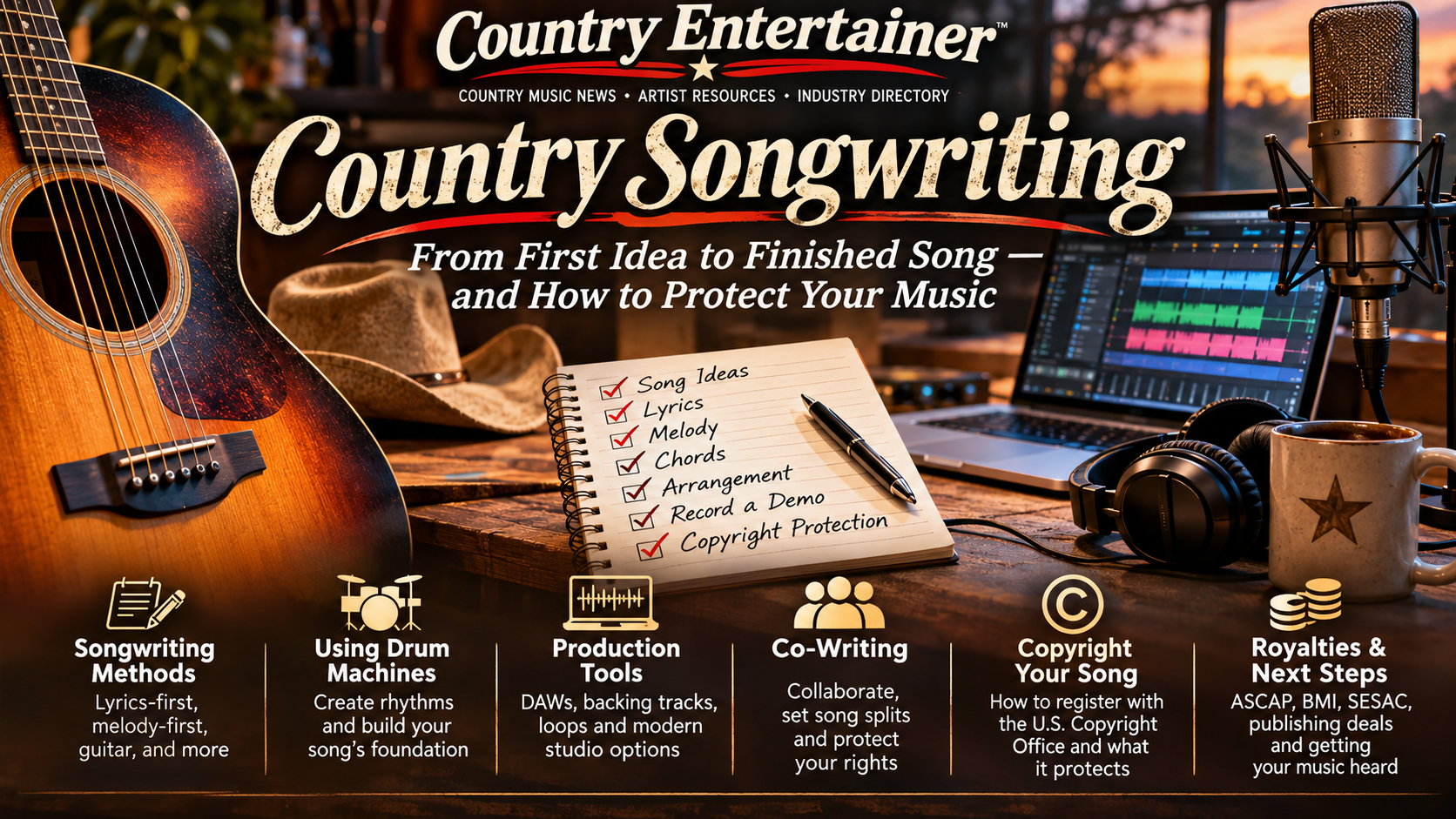
There isn't one correct songwriting method. You can write the words first, discover a melody, experiment with guitar chords, build a drum-machine beat or collaborate with someone who already has a backing track. Technology has expanded the possibilities, but a memorable song still depends on musical and emotional choices.
1. Writing the lyrics first
Begin with a title, story or central image. Ask what changes between the first verse and the final chorus. A working title such as The Last Light on the Porch might become a story about coming home, loss or forgiveness. Write more ideas than you need, then choose the lines that advance the story.
A common structure is Verse 1 → Chorus → Verse 2 → Chorus → Bridge → Final Chorus. The verses provide details; the chorus expresses the central idea; the bridge offers a new perspective. Read your lyrics aloud to check whether the natural stresses work when sung.
2. Starting with the melody
Some writers hear the melody before the lyrics. Hum or sing it into a voice recorder immediately, even if the first version uses nonsense syllables. Later, find words whose natural rhythm fits the tune. A compelling melody may reveal whether the song should feel playful, hopeful, urgent or reflective.
3. Guitar-first and chord-first songwriting
An acoustic guitar progression or fingerpicking riff can establish a mood before any lyrics exist. Repeat a few chords and experiment with vocal phrases. Don't worry if the initial progression is simple: memorable songs frequently rely on familiar harmonic patterns combined with distinctive melodies and storytelling.
4. Using a drum machine or rhythm track
Contemporary country and country-rock productions can begin with a programmed groove. Choose a tempo, place kick and snare hits, add hi-hats or percussion, then build a bass line and chords. Sing different melodies over the beat. The final recording can retain the programmed percussion or replace it with a live drummer. The rhythm is a tool, not a formula for a hit.
5. Writing over a backing track
A producer may supply an instrumental arrangement containing drums, bass, guitar and keyboards. The songwriter then creates melody and lyrics over it. Before releasing the result, confirm the instrumental's license and document who owns the underlying composition and sound recording. Purchasing a beat does not automatically convey exclusive rights. Producing or engineering a recording does not automatically make someone a co-writer; qualifying songwriting contributions and agreements matter.
6. Choosing recording and production tools
A digital audio workstation (DAW) lets you record, arrange and mix songs on a computer. GarageBand is approachable for beginners; Logic Pro, REAPER, Pro Tools, Ableton Live and FL Studio offer different recording and composition workflows. A simple setup can include a microphone, headphones, an audio interface and a guitar or MIDI keyboard. Capture the core song before adding elaborate production. Save dated versions of your sessions, voice memos and lyric drafts.
Loops, samples and AI tools: Check the licensing terms for commercially used loops or sampled recordings. An online sample isn't automatically free to use. AI tools may help brainstorm and mock up ideas, but under U.S. Copyright Office guidance, copyright requires sufficient human authorship. A prompt alone may not make machine-generated musical expression copyrightable. Keep records of your own creative contributions and be transparent where disclosure is required.
7. Co-writing and songwriter splits
Nashville co-writing sessions may involve a lyricist, a melody writer and a performer working together. Before a song is distributed or pitched, agree in writing on ownership and splits. A basic split sheet identifies the title, contributors, ownership percentages, signatures and contact details. Equal splits are common in some sessions, but not mandatory; the agreed shares should reflect what the co-writers accept. Ask an entertainment attorney to review complicated arrangements or disputes.
8. Recording a useful demo
A song demo can be a clear vocal accompanied by one guitar or piano, provided the melody, lyrics and timing can be understood. More elaborate demos might include bass, percussion and backing vocals. A demo is a communication tool: it should help a listener imagine the song, not bury it under unnecessary effects. Preserve original project files and dated drafts.
9. When copyright begins
Under U.S. law, copyright in sufficiently original, human-authored expression generally arises automatically when the work is fixed—for example, when lyrics are written down or an original melody is recorded. It does not require registration to exist. Copyright protects original expression, not general themes, musical styles, ordinary short phrases or titles by themselves.
A released song can involve two distinct copyrights:
- Musical composition: the underlying music and lyrics, often owned by songwriters or publishers.
- Sound recording/master: the specific recorded performance, which may have different owners.
An artist may own a song's composition while a record label owns or licenses the master. The exact arrangement depends on law and contract terms.
10. How to register a song with the U.S. Copyright Office
Start at the official registration portal: https://www.copyright.gov/registration/.
1. Prepare the finished work and identify the qualifying authors and rights owners. 2. Determine whether you are registering the musical composition, sound recording, or an eligible combination of both. 3. Complete the appropriate online application accurately, including title, authorship, ownership and publication information. 4. Pay the applicable filing fee shown at https://www.copyright.gov/about/fees.html. 5. Submit the required deposit copy or file according to the Office's instructions. 6. Save your filing confirmation and eventual registration certificate.
Some eligible works may qualify for special group-registration options. Composition and recording registrations may sometimes be combined when the applicable ownership and other requirements are met. A songwriter should review the Copyright Office's current instructions or obtain professional advice before filing, particularly when there are multiple contributors, transfers or AI-generated materials.
Why register? For U.S. works, registration or refusal is generally required before filing a federal infringement lawsuit. Timely registration can also affect the availability of statutory damages and attorney's fees, subject to legal conditions and exceptions. Registration is not a guarantee against copying or infringement.
Uploading a song to YouTube or Spotify, mailing a copy to yourself or storing a file in the cloud is not equivalent to federal copyright registration.
11. Copyright registration is not royalty collection
Registering with the Copyright Office does not automatically enroll you in royalty collection systems. Songwriters may need to register works with the appropriate organizations depending on their activity and agreements:
- ASCAP — performing-rights organization.
- BMI — performing-rights organization.
- SESAC — performing-rights organization with its own affiliation requirements.
- The MLC — administers certain U.S. digital mechanical royalties for eligible musical works.
These organizations perform different functions; joining one does not necessarily cover every type of royalty. Check each organization's official guidance and the terms of any publishing agreement.
12. Protect yourself before a publishing or record agreement
A publisher, label or distributor may request rights in your songs or recordings. Review what copyrights are assigned or licensed, revenue shares, territory, duration, exclusivity, recoupable advances, accounting and audit rights, and when rights might revert. A recording contract and a publishing contract are not the same thing.
Always obtain independent legal advice from an experienced entertainment attorney before signing a contract involving your music.
13. A sustainable songwriting routine
Build a repeatable process: collect ideas on Monday; develop lyrics on Tuesday; experiment with melody and chords on Wednesday; record a demo on Thursday; revise on Friday; then play it for trusted listeners over the weekend. Your process can be completely different—the point is to create consistently and preserve your ideas.
How Country Entertainer can help
CountryEntertainer.com is building resources that help writers and artists find collaborators, recording studios, producers, country music businesses, music venues and entertainment lawyers. Explore the Country Artists, Live Music Venues, Country Music Business and Entertainment Lawyers directories. An artist profile can help introduce your work and direct interested listeners or industry professionals to official music links.
Final thoughts
Great country songwriting can begin with a notebook, a guitar, a rhythm track or a laptop—but creative choices and genuine storytelling make the difference. Write frequently, document your contributions, agree on ownership with collaborators, and understand the legal and business rights attached to your music.
Country Entertainer — Discover. Connect. Learn. Grow.
Sources and further reading
- U.S. Copyright Office — Register Your Work
- Copyright Information for Musicians
- Copyright Office — Fees
- Copyright and Artificial Intelligence
Final disclaimer: This guide is general education, not legal, accounting or financial advice. Registration requirements and laws can change. Seek advice from a qualified attorney for questions about co-writing, song ownership, AI, sampling, infringement or contracts.